A sewer line problem rarely announces itself loudly. Most of the time it starts quietly — a drain that's just a little slower than it used to be, a faint smell you can't quite place, or a soft spot in your yard you keep meaning to look into. By the time the issue becomes obvious, the damage has usually been building for months or years.
Fort Wayne homeowners face some specific challenges when it comes to sewer lines. A significant portion of the city's housing stock was built in the mid-20th century, which means a lot of the area's residential sewer lines were installed using clay or cast iron pipe — materials that were standard at the time but are now well past their intended lifespan. Fort Wayne City Utilities has acknowledged that aging infrastructure, including older brick sewers, requires ongoing inspection and repair throughout the system. The same aging reality applies to the private lateral lines that run from individual homes to the city connection.
This guide breaks down how to spot a failing sewer line early, what your repair options actually are, and how to decide whether a targeted repair or a full replacement makes more financial sense for your situation.
- Your Sewer Line: What's Your Responsibility?
- Warning Signs Your Sewer Line Is Failing
- Pipe Types Common in Fort Wayne Homes
- Repair Options: What's Available and What Each Costs
- Repair vs. Replace: How to Decide
- What to Expect During Sewer Line Work
- Choosing the Right Contractor
- Prevention: Protecting the Line You Have
Your Sewer Line: What's Your Responsibility?
Before diving into warning signs and costs, it's worth understanding exactly what you own. Your home's sewer system includes everything from your drains and toilets to the main sewer lateral — the pipe that runs from your house, across your property, and connects to the city's main sewer line at the street.
That entire lateral, from foundation to city hookup, is your responsibility as a homeowner. The city is only responsible for the main line running under the street. If something fails in your lateral — whether it's a blockage, a crack, tree root intrusion, or a collapsed section — the cost of diagnosing and fixing it falls on you.
For Fort Wayne homeowners, that lateral is often 40 to 60 feet long depending on how far the house sits from the street. At $50 to $250 per linear foot for repair or replacement, understanding what you're working with before something goes wrong can save you from a very expensive surprise.
Warning Signs Your Sewer Line Is Failing
Sewer line issues are much easier and cheaper to fix when caught early. Here are the symptoms to watch for:
Slow Drains Throughout the House
A single slow drain usually points to a clog in that fixture's individual drain line. But when multiple drains in your home — the tub, the bathroom sinks, the kitchen — are all draining slowly at once, that's a strong indicator the problem is in the main sewer line, not individual branches. It means water is having trouble getting through the primary pipe that serves the whole house.
Gurgling Sounds from Drains or Toilets
A gurgling sound after flushing or draining is your plumbing telling you it's fighting for airflow. Water moving through a partially blocked line displaces air, and that air has to go somewhere. When it bubbles back up through your fixtures, that gurgling is the sound of a struggling sewer line.
Sewage Odors Inside or Around the House
A properly functioning sewer line is sealed. If you're smelling sewage — either in the basement, near floor drains, or in your yard — something has cracked, separated, or failed. The smell is not just unpleasant; it's a health concern. Sewer gas contains hydrogen sulfide and methane, both of which are harmful at elevated concentrations.
Wet Spots or Unusually Green Patches in the Yard
If part of your yard stays wet long after rain, or if you notice a patch of grass that's noticeably greener and lusher than the area around it, there may be a leaking sewer line below. Sewage acts as a fertilizer, which is why plants directly above a leak often look healthier than the surrounding lawn — at least until the ground softens enough that you notice a depression forming.
Sewage Backing Up Into Fixtures
This is the most obvious sign and typically means the line is severely blocked or has collapsed. When sewage backs up into your basement floor drain, bathtub, or toilets, the main line is no longer moving waste away from the house. This is a plumbing emergency and needs attention immediately.
Sinkholes or Soft Ground in the Yard
A leaking sewer line washes soil away from around the pipe over time, leaving a void underground. When that void gets large enough, the ground above it begins to sink or feel soft underfoot. A sinkhole or depression in your yard directly above where your sewer line runs is a serious sign of pipe failure.
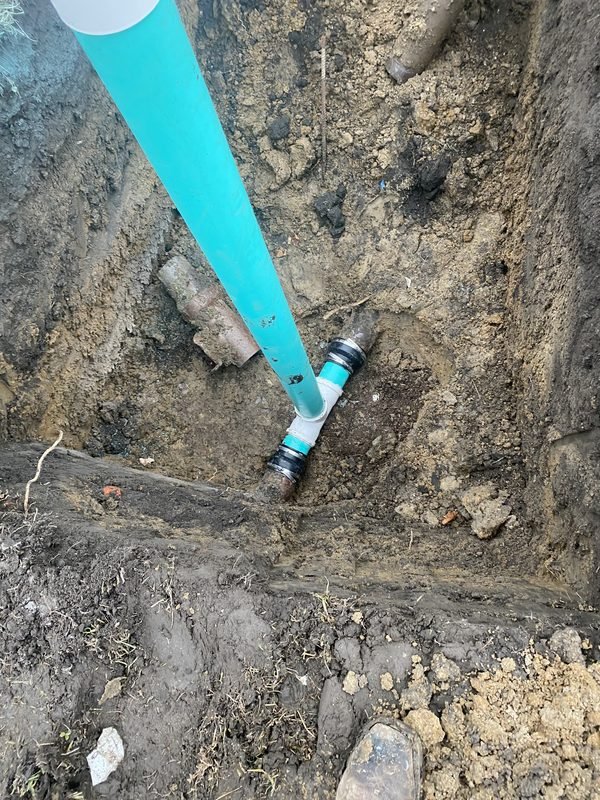
Open trench sewer line work in Northeast Indiana. DZ Contracting handles the full job from excavation through backfill and site restoration.
Pipe Types Common in Fort Wayne Homes
The type of pipe in your sewer line has a major impact on how vulnerable it is and what repair options make sense. In Fort Wayne's housing market, you're most likely to encounter one of three pipe materials depending on when your home was built.
Clay Pipe (Pre-1970s Homes)
Clay tile sewer pipe was the standard for residential construction through much of the mid-20th century. It actually has decent chemical resistance to the acids in wastewater, but it's brittle, it fails at the joints, and tree roots find it irresistible. Clay pipe has a lifespan of roughly 30 to 60 years, which means clay lines installed in the 1950s and 1960s are well past their expected service life. If your home was built before 1970 and has never had the sewer line inspected, this is worth knowing.
Cast Iron Pipe (1950s–1980s Homes)
Cast iron is heavier-duty than clay and holds up better to external pressure, but its weakness is corrosion. Over time, cast iron rusts from the inside out as it reacts with the sulfur in sewage. If your home was built before 1980, there's a good chance you have cast iron or clay pipes that are reaching the end of their useful life. Cast iron lines that are actively corroding will show scale buildup inside the pipe, which narrows the flow capacity and creates sites where clogs develop repeatedly.
PVC Pipe (1980s–Present)
PVC is the modern standard and is far more durable for this application. It doesn't corrode, tree roots have a harder time penetrating it, and it handles ground movement better than rigid clay or cast iron. PVC sewer lines last 50 to 100 years, so a home built in the 1990s with original PVC shouldn't be a sewer concern for decades yet — though tree root intrusion and improper installation can still cause problems even in PVC lines.
Repair Options: What's Available and What Each Costs
Not every sewer problem requires digging up your yard. The right repair method depends on the type and extent of the damage. Here's a breakdown of the main options and what each typically costs for Fort Wayne area projects:
| Repair Method | Best For | Typical Cost |
|---|---|---|
| Drain Snaking | Minor clogs, soft blockages | $200 – $500 |
| Hydro Jetting | Grease buildup, roots, heavy clogs | $600 – $1,400 |
| CIPP Pipe Lining | Cracks, root infiltration, corrosion in intact pipe | $90 – $250 per linear foot |
| Pipe Bursting | Deteriorated pipe, full replacement trenchless | $60 – $200 per linear foot |
| Traditional Excavation & Replace | Collapsed pipe, severe damage, inaccessible line | $50 – $250 per linear foot |
For a full sewer lateral replacement in Fort Wayne — typically 40 to 60 feet — most homeowners are looking at a total project cost between $2,760 and $11,040, depending on the repair method, pipe depth, and site conditions. Projects that require concrete cutting, driveway restoration, or complicated access will run toward the higher end of that range.
Trenchless vs. Traditional: Which Is Right?
Trenchless methods like pipe lining (CIPP) and pipe bursting are appealing because they minimize excavation and yard disruption. But they're not the right solution for every situation. Pipe lining only works if the existing pipe still has structural integrity — if the line has collapsed or bellied significantly, there's nothing to line against. Pipe bursting works well for replacing deteriorated pipe but still requires access pits at each end of the run. Traditional excavation remains the most reliable option for collapsed lines, deeply bellied sections, or situations where the pipe route needs to be rerouted entirely.
A camera inspection before deciding on a repair method is strongly recommended. According to HomeGuide's 2026 data, a sewer camera inspection costs $125 to $500 — a small investment that can save thousands by ruling out the wrong repair approach before work begins.
DZ Contracting handles the excavation side of sewer line work — trenching, pipe replacement, backfill, and site restoration. For camera inspections and lining work, we can coordinate with licensed plumbing contractors in the Fort Wayne area to make sure your project gets handled correctly from diagnosis through completion.
Repair vs. Replace: How to Decide
This is the question most homeowners struggle with, and it's one where honest advice from a qualified contractor matters a lot. Here are the situations that typically point toward each option:
Repair Makes Sense When:
- The damage is isolated to one section and the rest of the line is in good condition
- The pipe material is PVC or relatively young cast iron that hasn't deteriorated broadly
- The total repair cost is well under 50% of what full replacement would cost
- A camera inspection confirms the damage is localized and the pipe structure is otherwise sound
Replacement Makes More Sense When:
- The pipe is clay or cast iron from before 1980 and showing widespread deterioration
- You've had recurring clogs, backups, or repairs on the same line within the past few years
- A camera inspection shows damage in multiple locations along the run
- The repair cost would exceed 50% of what a full replacement would cost — at that point you're investing heavily in an old pipe that will likely fail elsewhere soon
- The line has collapsed or bellied to the point where trenchless options aren't viable
A useful rule of thumb: if you're considering a repair on a pre-1980 clay or cast iron line, get a full camera inspection of the entire lateral first. It will tell you whether you're fixing one problem or putting a patch on a pipe that's failing in multiple places.
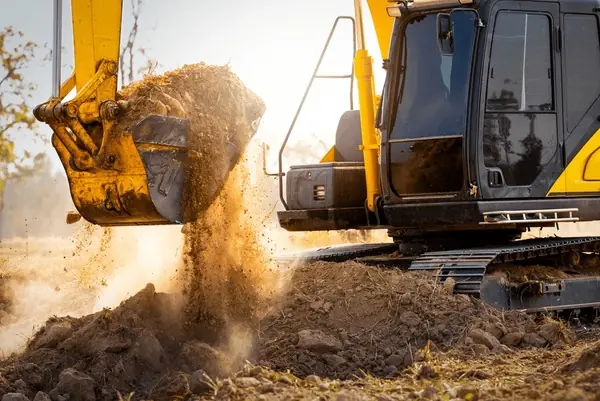
When excavation is needed, the right equipment and an experienced crew make the difference between a clean job and a messy one.
What to Expect During Sewer Line Work
If your sewer line work requires excavation, here's the general sequence of events so there are no surprises:
- Camera inspection and diagnosis. Before any digging, a camera is run through the line to identify the exact location and nature of the problem. This determines the repair method and gives everyone a clear scope of work before anything is quoted.
- Indiana 811 utility locate. Any excavation in Indiana requires a call to Indiana 811 at least two full business days before digging. Underground gas, water, electric, and telecom lines all need to be marked before a shovel goes in the ground. DZ Contracting handles this on every project.
- Permitting. Most sewer line work in Fort Wayne requires a permit. Your contractor should pull this as part of the project. Budget $30 to $500 for permitting depending on the scope of work.
- Excavation and pipe replacement. For traditional open-cut replacement, the trench is dug, the old pipe is removed, new pipe is set and connected, and the trench is backfilled in lifts and compacted properly. DZ Contracting handles this phase — the heavy excavation, pipe bedding, and backfill — to the standards the city inspection will require.
- Inspection and backfill. The city may inspect the work before the trench is closed. Once approved, the trench is fully backfilled and the surface is restored. Lawn restoration, concrete, or asphalt repair may be needed depending on what the trench crossed.
Most residential sewer lateral replacements take one to two days of active work, though permitting and inspection scheduling can extend the overall project timeline. Trenchless methods are typically faster but follow the same general permit and inspection process.
Choosing the Right Contractor
Sewer line work involves both plumbing and excavation, and the right contractor for your project depends on what the job requires. Here's what to look for:
- Start with a camera inspection from a licensed plumber. Before anyone starts digging, you need a professional diagnosis. A plumber with camera inspection capability can tell you exactly what you're dealing with and confirm whether the damage is localized or widespread.
- For excavation work, use a contractor with site work experience. Trenching a sewer lateral isn't just digging a hole — proper bedding, compaction, and backfill procedures matter for long-term pipe stability and for passing city inspection. DZ Contracting has handled sewer line excavation and replacement throughout the Fort Wayne and Columbia City areas and can coordinate the heavy site work component of your project.
- Get multiple quotes on larger jobs. For a full lateral replacement, get at least two or three estimates. Make sure each quote specifies the method, pipe material, backfill specification, and whether permits and inspection fees are included.
- Confirm permits are included. Ask directly whether your contractor will pull the required permits. A contractor who suggests skipping permits on a job that requires them is cutting a corner that could create problems when you sell the house.
- Check for Indiana licensing. Indiana requires plumbers to be licensed. Verify your contractor's license before work begins, especially for any work involving the connection to the city sewer main.
Prevention: Protecting the Line You Have
If your sewer line is in decent shape, a few straightforward habits can help extend its life and reduce the risk of an expensive emergency repair:
- Be strict about what goes down the drain. Grease and cooking fat solidify in cold pipes and build up into blockages over time. Wipes — even products labeled "flushable" — do not break down in sewer lines and are a leading cause of clogs. Toilet paper only.
- Know where your large trees are relative to your sewer line. Tree root intrusion is one of the most common causes of sewer line failure, especially in older clay and cast iron lines. Roots can extend 50 feet or more from a tree's base. If you have large maples, oaks, or elms near the path of your sewer line, periodic camera inspection is worth it.
- Consider a camera inspection if your home is over 30 years old and the line has never been looked at. A $200–$500 inspection is a cheap way to find out whether you have deterioration developing before it turns into a $10,000 emergency.
- Get repeat clogs addressed at the root cause, not just cleared. If you're snaking the same drain every year, the clog is a symptom of a structural issue in the pipe. Clearing it repeatedly without addressing the underlying problem is spending money without solving anything.